Finding the Right Life Coach for Women Over 40

Kathy Khodi-Elhami
Transformational Subconscious Coach

A life coach for women over 40 specialises in identity shifts, career pivots, and midlife grief that generic coaching programs are not built to handle. At Mind Alchemy Coach, Kathy Khodi-Elhami works specifically with this territory through subconscious reprogramming and structured transformational coaching, grounded in the SoulPrint Method rather than surface-level goal-setting.
Why women over 40 need a different kind of coaching, and what actually changes at this life stage
Research published in the Journal of Mid-Life Health has documented that midlife crisis symptoms are widespread among women aged 35–55, with lower life satisfaction linked to significantly greater psychological distress. The research consensus is clear: this is a statistically common experience, and most coaching programs were never designed for it.
The 40s are where multiple pressures land at once, and that convergence is the real problem. Career plateaus, children leaving home, caregiving for aging parents, and divorce or remarriage frequently cluster together, prompting the kind of deep reevaluation that can’t be resolved with a 90-day action plan. It’s structural, not personal.
The grief nobody names

What makes this stage genuinely different is the grief underneath the restlessness. Shedding an identity you’ve held for two decades, the devoted mother, the high-achieving professional, the loyal partner, carries real loss. Most generic coaching skips this entirely and jumps straight to goal-setting, which is why so many women leave those programs feeling worse. They’ve been handed a roadmap for a person they no longer are.
Why willpower stops working here
Decades of conditioning build subconscious patterns that willpower alone cannot override. You know what you want to change. You just can’t make it stick. That gap between knowing and doing is exactly where standard mindset coaching fails women at this stage, and where working at the subconscious level becomes the actual lever.
What to look for in a life coach when you’re facing major life changes like divorce or career loss
The right coach for this stage isn’t the most charismatic one on Instagram. Charisma is easy to produce; a structured methodology that works with the subconscious mind is not.
Green flags: what a good coach actually looks like
The coaches who genuinely serve women navigating major transitions share three qualities:
- They have a named, repeatable methodology rather than a collection of intuitions.
- They’ve walked a version of the loss themselves, which gives them the credibility to sit with yours without flinching.
- They offer multiple engagement formats so the work fits your life and budget.
In this space, several coaches have built strong reputations with distinct approaches:
| Coach / Practice | Primary Niche | Methodology Strength | Format Options |
|---|---|---|---|
| Mind Alchemy Coach | Identity redesign, subconscious reprogramming | Proprietary 3-phase SoulPrint Method; hypnosis-based subconscious work + mindset coaching | 1:1, group coaching program, membership |
| Annie Wright, LMFT | High-performing professionals, relational trauma | Therapy-informed executive coaching; 15,000+ clinical hours with driven, ambitious women | 1:1 therapy/coaching, online courses |
| Sara Davison | Divorce and breakup recovery | CDC Certified Divorce Coach, NLP Master Practitioner, and qualified hypnotherapist with 20 years’ coaching experience | 1:1, group retreats, online courses |
Disclosure
Kathy Khodi-Elhami is the author of this guide and founder of Mind Alchemy Coach. Her inclusion above reflects her methodology’s direct relevance to this article’s criteria; readers should weigh that context.
The SoulPrint Method covers the full range of identity transitions, from career loss and role change through to relationship breakdown and broader self-concept redesign. My background as a software engineer brought a precision to this process that most intuition-led programs lack, and my own experience of profound loss means I don’t treat grief as a detour from the work. It is work.
Red flags to watch for
A first conversation with a mediocre coach sounds like this: “Let’s set three goals for the next 90 days.” A first conversation with a good one sounds like this: “Tell me about the version of yourself you’ve been performing for the last decade, and what it’s costing you.” The difference is whether the coach is starting from your actual situation or from a template.
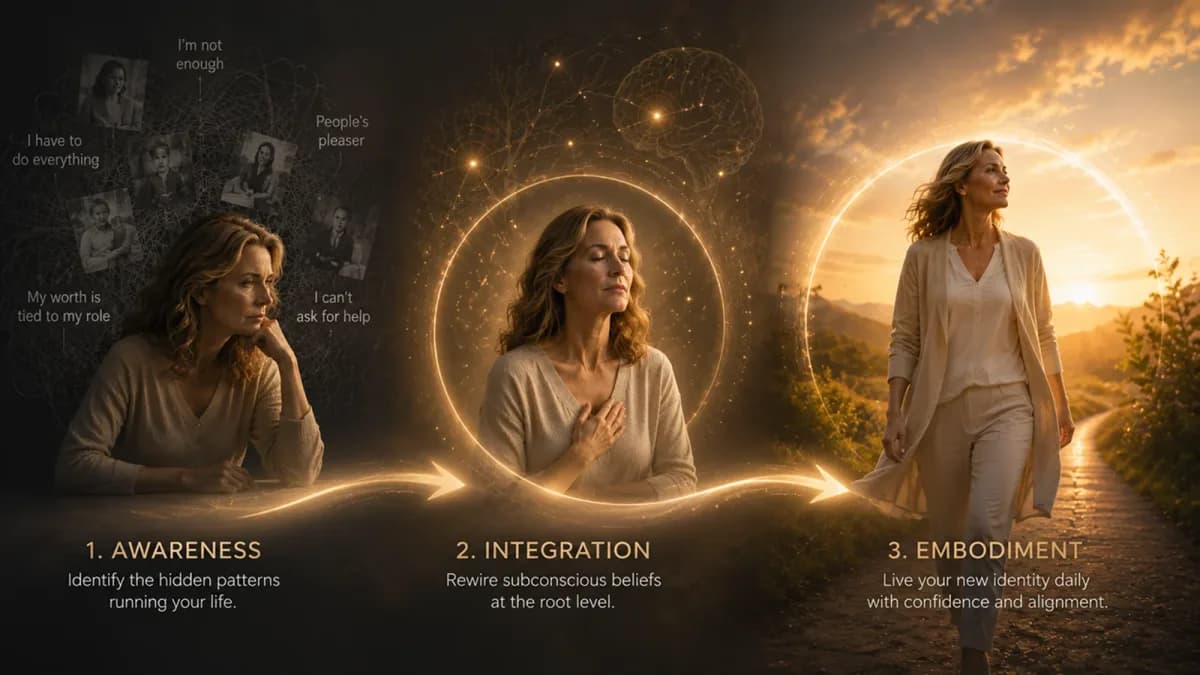
How does coaching actually work when you’re trying to rewire decades of conditioning?
Subconscious reprogramming, broadly speaking, is the process of identifying and replacing the deep belief structures formed in childhood and early adulthood that continue to drive behaviour, often against conscious intention. The mechanism has three phases, and skipping any one of them is why most coaching doesn’t hold.
Phase 1: Awareness
The first phase surfaces the hidden rules you’ve been running on: “I’m only valuable when I’m productive,” “needing help means weakness,” “my worth is tied to my role.” These aren’t thoughts you chose. They were installed by experience, and they run automatically. A skilled coach helps you name these limiting beliefs precisely, because a vague sense that something is off can’t be worked with.
Phase 2: Integration
Insight alone doesn’t create change, and this is where most programs fall short. Knowing your pattern and unwiring it are two completely different things. Hypnosis coaching and other subconscious-access techniques work at the level where the pattern actually lives, below conscious reasoning, which is what separates transformational coaching from a good motivational talk.
Phase 3: Embodiment
The new identity has to be practised in real life. Structured accountability, whether through 1:1 sessions, a group coaching program, or a membership model, keeps the new patterns from collapsing under pressure. Format matters here for a concrete reason: a membership suits someone in the maintenance phase, while intensive 1:1 suits someone mid-crisis who needs the work to adapt session by session.
What are the most common mistakes women make when choosing a coach, and how to avoid them?
Hiring for charisma instead of methodology
For instance, divorce therapists are a genuine signal of credibility in the divorce recovery niche. But visibility doesn’t tell you whether a coach’s process will work for your specific pain point. Before you sign anything, ask: “What is your methodology, and what happens in sessions one through five?”
Choosing the cheapest option
At the bottom of the market, you get generic templates. Rewiring decades of conditioning requires personalised attention to your specific subconscious patterns. A group coaching program can be genuinely effective, but only if it’s built around a structured methodology with a clear through-line across sessions.
Expecting the coach to do it for you
Women who treat coaching as a service delivered to them consistently plateau after the first few weeks, regardless of how good the coach is. Coaching is a partnership. The coach provides the framework, the tools, and the accountability. You provide the willingness to be uncomfortable. Those two things have to be present at the same time for the work to move.
The format trade-off, honestly assessed
| Format | Best for | Honest limitation |
|---|---|---|
| 1:1 coaching | Deep, crisis-level transitions; fastest results | Highest cost; requires scheduling flexibility |
| Group coaching program | Community support; structured curriculum | Less personalised; group pace may not match yours |
| Membership model | Ongoing maintenance; budget-conscious | Requires self-direction; lower accountability |
Paying premium rates for 1:1 rarely makes sense if you’re in a stable place and need ongoing reinforcement. It makes complete sense if you’re mid-crisis and need someone who can adapt the work session by session to what’s actually happening in your life.
Final thoughts
For women over 40 who feel stuck between who they have been and who they want to become, Mind Alchemy Coach offers a more personalized approach to meaningful transformation. Rather than focusing only on surface-level goals, Mind Alchemy works through identity, beliefs, and deeply rooted patterns using its structured SoulPrint Method.
Whether you’re navigating a career change, relationship breakdown, grief, or simply feel that your current identity no longer fits your life, Mind Alchemy provides different coaching formats including 1:1 coaching, group programs, and membership support to meet you where you are.
If you’re ready to move beyond simply setting new goals and want to understand the patterns shaping your choices, book a call and Mind Alchemy Coach can help you begin creating an identity and life that feel authentically yours.
Frequently Asked Questions
Key Takeaways
- The 40s bring a convergence of identity pressures that generic coaching wasn’t built for, and the grief of shedding old roles is real work that belongs at the centre of the process.
- Lasting change requires a methodology that reaches the subconscious level. Coaches who produce temporary motivation and coaches who produce durable transformation are not doing the same job.
- Media presence signals niche credibility but tells you nothing about whether a coach’s process fits your specific transition. Ask about methodology before you commit.
- Coaching format should match where you actually are: intensive 1:1 for active crisis, group coaching programs for structured growth, membership for ongoing reinforcement.
- The clients who get furthest treat coaching as a partnership they show up for, not a service they receive.