How to Reprogram Your Subconscious Mind: 7 Proven Techniques

Kathy Khodi-Elhami
Transformational Subconscious Coach

Subconscious mind reprogramming is the deliberate process of identifying and replacing automatic beliefs, emotional patterns, and behavioral programs stored below conscious awareness with new ones that align with your intended identity and goals.
The good news is that your subconscious is not fixed. With consistent repetition, emotional engagement, and the right techniques, you can gradually replace old mental programs with healthier patterns that support lasting change.
At Mind Alchemy, this is the core of every client engagement. Your subconscious runs roughly 95% of your daily behavior, according to research by social psychologist John Bargh at Yale, and it operates on emotion and repetition, not logic. That is why willpower alone rarely creates lasting change.
Quick Answer
Subconscious mind reprogramming is the process of replacing automatic beliefs, emotional patterns, and habits with healthier ones that better align with your goals. Because your subconscious influences much of your daily thinking and behavior, lasting change typically requires consistent practice rather than willpower alone. Effective techniques include:
- Visualization to mentally rehearse new behaviors and outcomes.
- Bridging affirmations that feel believable and reinforce gradual change.
- Guided hypnosis to access subconscious beliefs with less conscious resistance.
- Journaling and self-inquiry to uncover hidden thought patterns.
- Identity-level reframing to change how you see yourself, not just what you do.
- Breathwork to calm the nervous system and improve receptiveness to change.
- Working with a coach for deeply rooted beliefs that are difficult to shift alone.
These techniques are most effective when practiced consistently over time. In this guide, you will learn how each method works, when to use it, and simple ways to start reprogramming your subconscious today.
Why Your Conscious Mind Keeps Losing to Your Subconscious
Your conscious mind is not in charge as often as you think. John Bargh and Tanya Chartrand’s foundational research on automaticity, published in American Psychologist in 1999, established that the vast majority of human behavior is automatic, with estimates in the literature ranging from roughly 90 to 97 percent and most researchers settling around 95 percent. That is how the brain is designed to operate.
What makes this frustrating in practice is that awareness of a subconscious program does nothing to stop it from running. Awareness is a conscious process; the program operates in the implicit memory system, which is structurally distinct from the explicit system where insight lives. Research consistently shows that explicit-level understanding does not automatically transfer to implicit-level change.
Knowing you self-sabotage does not stop you from doing it. The subconscious needs a different kind of input, one that speaks its language: emotion, imagery, repetition, and nervous-system state.
Can You Really Reprogram Your Subconscious Mind?
Yes, but it takes more than positive thinking or willpower. Your subconscious is shaped by years of experiences, emotional memories, and learned beliefs. The good news is that these patterns are not permanent. Thanks to neuroplasticity, the brain’s ability to form new neural connections throughout life, it can adapt and develop healthier ways of thinking and responding.
Many subconscious beliefs are formed through childhood experiences, relationships, and emotionally significant events. Over time, they become automatic, influencing your thoughts and behaviors without conscious effort. That is why simply recognizing a limiting belief rarely leads to lasting change.
Instead, lasting change comes from consistently reinforcing new thoughts, emotions, and behaviors. Techniques like visualization, guided hypnosis, breathwork, journaling, and identity-based coaching help strengthen healthier neural pathways while reducing the influence of old patterns.
The goal is not to erase your past but to gradually replace limiting beliefs with ones that better support your confidence, relationships, and goals. If you are not yet sure which beliefs are driving your patterns, the guide on how to identify and overcome limiting beliefs is a useful place to start.
What Makes Subconscious Reprogramming Effective?
The most effective techniques work because they engage the subconscious in the ways it naturally learns:
- Repetition strengthens new neural pathways over time.
- Emotion helps the brain prioritize and retain new experiences.
- Mental imagery allows your brain to rehearse desired responses before they happen in real life.
- Identity-based thinking changes behavior by shifting how you see yourself, not just what you do.
- A calm nervous system makes the brain more receptive to learning than a state of chronic stress.
Once you understand these principles, the techniques below become much more than self-help exercises. They become practical tools for gradually changing the subconscious patterns that shape your everyday life.
Seven Techniques to Reprogram Your Subconscious Mind
1. Visualization and Mental Rehearsal
Neuroscience confirms that mental rehearsal activates the same neural networks as real-life experience, meaning your brain can practice new emotional and behavioral patterns without physically doing them. Pascual-Leone’s 1995 piano experiment, published in the Journal of Neurophysiology, demonstrated this concretely: five days of mental practice produced cortical motor map expansion statistically indistinguishable from five days of physical practice.
The detail most people miss is that vague, aspirational imagery does almost nothing. What makes visualization work at the neural level is precision: a specific scene, specific sensory detail, specific emotional state.
Try this today
Close your eyes for 60 seconds. Picture a specific moment tomorrow where you respond exactly as the person you are becoming would respond. Include the room, the feeling in your chest, the words you say. Sensory specificity is what makes it land.
2. Affirmations, and Why They Often Fail Alone
Affirmations are frequently misapplied. Positive self-statements are widely believed to boost mood and self-esteem, yet Wood, Perunovic, and Lee’s study in Psychological Science found that participants with low self-esteem who repeated a positive self-statement felt worse than those who said nothing.
The mechanism is simple: when a statement is too far from your current self-image, your mind argues back rather than accepting it.
The fix is bridging statements. Instead of “I am wealthy,” try “I’m building the habits that create financial security.” Your subconscious can accept a direction without rejecting a destination it does not yet believe.
Try this today
Rewrite one affirmation you have been using. Make it a process statement (“I am learning to…” or “I’m becoming someone who…”) rather than a state claim.
3. Guided Hypnosis Coaching
During hypnosis, the brain enters a relaxed state associated with heightened focus and reduced mental resistance. In this state, the subconscious becomes more receptive to new information, and guided language, imagery, and emotional cues help the mind release outdated associations and replace them with healthier responses. The critical conscious filter quiets, which is the whole point.
This is where hypnosis coaching earns its place in a serious subconscious reprogramming practice. You remain aware throughout the session.
Try this today
Find a 15-minute guided self-hypnosis recording focused on your specific pattern. Listen with headphones, lying down, just before sleep, when your brain is already shifting toward slower brainwave states.
4. Journaling and Self-Inquiry Prompts
Journaling works because it forces the implicit to become explicit. Writing slows thought down enough to catch the beliefs running underneath it.
The prompts that actually surface subconscious material are not “what am I grateful for?” They are questions like: what would I have to believe about myself for this pattern to make sense? Or: what is the earliest memory I have of feeling this way?
Try this today
Write for 10 minutes on this prompt: “The story I keep telling myself about why I can’t have the thing I want is…” Do not edit. Let the subconscious speak first.
5. Identity-Level Reframing
Most mindset coaching targets behavior. Identity-level reframing targets the self-concept underneath it. When the subconscious begins to accept a new internal truth (“this is who I am now” rather than “I am trying to change”), effort decreases and consistency becomes natural, because the behavior is no longer fighting the identity generating it.
This is the approach at the core of self-identity coaching: you do not just change what you do, you change who you are.
Try this today
Write down three behaviors your future self does automatically. Then ask: what does a person who does those things believe about themselves? Start acting from that belief today, even once.
6. Breathwork as a Nervous System Precursor
You cannot reprogram a nervous system that is in threat mode. Respiration is both automatic and voluntary, giving it a unique role as a bidirectional bridge between conscious intention and subconscious regulation. Slow, rhythmic breathing activates afferent pathways connected to the vagus nerve, increasing parasympathetic tone and reducing sympathetic overactivation.
Visualization done in a dysregulated state barely touches the subconscious. The same visualization done after two minutes of extended exhale breathing lands in a completely different way, because the system is no longer treating new input as a threat.
Try this today
Before any other practice, breathe in for 4 counts and out for 8. Do this for 2 minutes. Notice the shift in your body before you begin the real work.
7. Working With a Coach for Patterns That Will Not Shift Alone
Some patterns need a witness. A skilled mindset transformation coach can see the belief structure you are inside of, which you literally cannot see from within it.
Try this today
Write down one pattern you have tried to change more than three times without lasting success. That is your signal that self-guided work has hit its ceiling for this particular issue.
Self-Guided vs. Coach-Supported: A Quick Comparison
| Approach | Best for | Limitation | Best starting point |
|---|---|---|---|
| Solo visualization | Building new neural habits | Requires self-awareness of the root belief | Use from day 1 of any new goal |
| Affirmations | Reinforcing existing confidence | Backfires when the belief gap is too large | Use from day 1, alongside a bridging statement |
| Journaling | Surfacing hidden patterns | Does not resolve trauma-level material | Use from day 1; increase frequency if patterns feel stuck |
| Guided hypnosis | Bypassing conscious resistance | Depth depends on practitioner quality | After 2+ weeks of solo practice with no noticeable shift |
| Breathwork | Nervous-system priming | Preparation tool, not a standalone method | Use before every session from the start |
| 1:1 coaching | Deep identity and trauma patterns | Higher investment required | After 60 days of consistent solo effort with no movement |
| Group coaching program | Accountability and community | Less personalized than 1:1 | When you want structure and peer support before committing to 1:1 |
When to Work With a Subconscious Reprogramming Coach
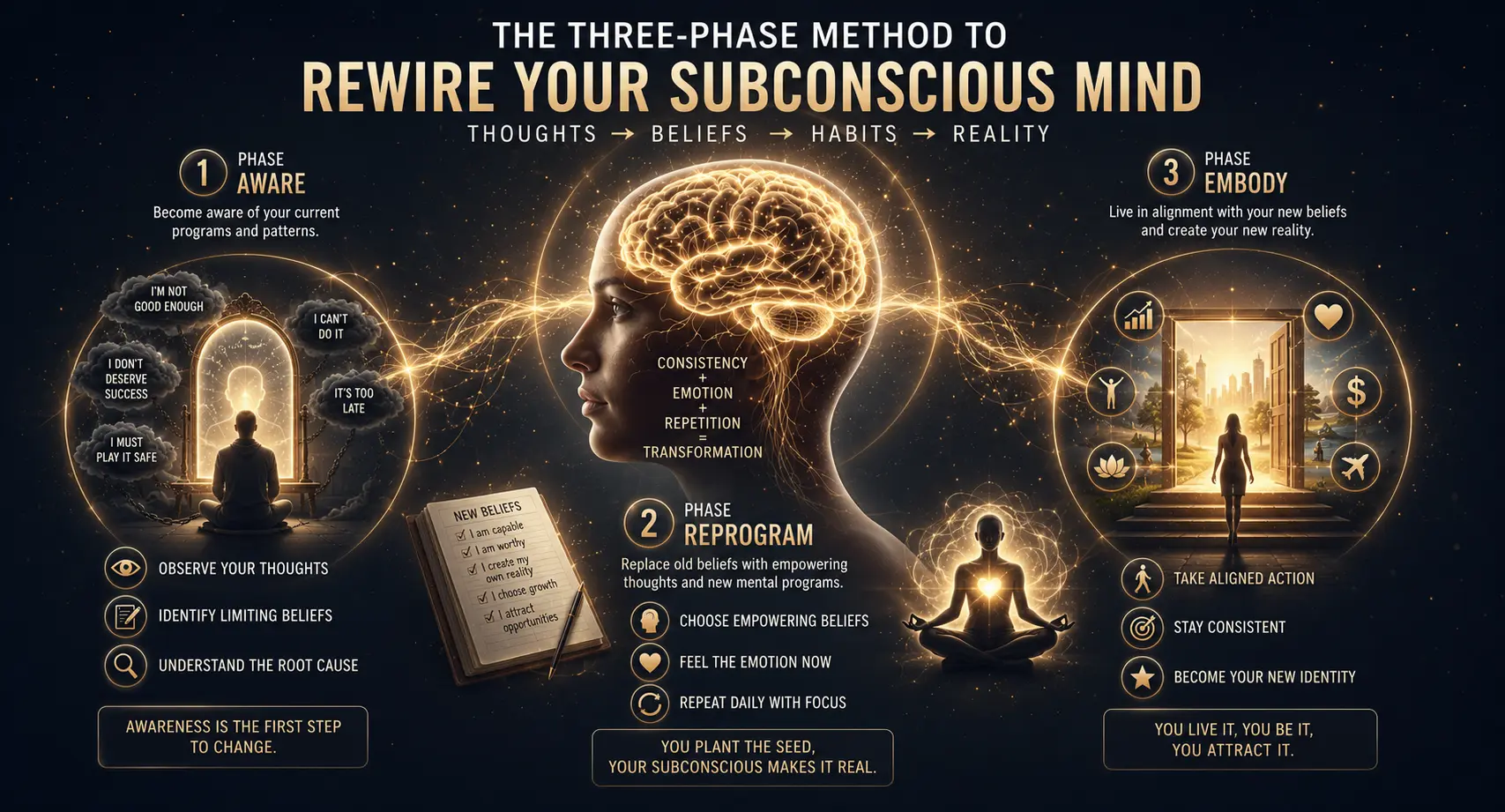
Self-guided work can create meaningful progress, but many people eventually reach patterns that are difficult to change without outside guidance. The patterns that remain after consistent solo effort tend to share one characteristic: they are identity beliefs, often formed before age 10 and sometimes reinforced by loss or relational trauma, not just habits that can be overwritten with repetition.
A subconscious reprogramming coach tracks the pattern across sessions, notices the moment you deflect or minimize, and works at the nervous-system level rather than only the cognitive one.
Kathy’s proprietary 3-phase SoulPrint Method applies that kind of structural precision to subconscious work. High-energy motivational approaches build conscious momentum well, but they do not address the hypnosis-based subconscious layer where the deepest patterns live.
Every session is held online, so where you live is not a constraint. Kathy works with clients across the UK and the US, including subconscious reprogramming coaching in London and New York.
How to Implement These Techniques: Step by Step
- 1Identify one target pattern. Pick the single recurring behavior or emotional reaction you most want to change. Vague intentions scatter effort; one clear pattern focuses it.
- 2Run a 2-minute breathwork primer. Before any reprogramming session, use the 4-count inhale, 8-count exhale pattern to shift your nervous system into a receptive state. Most people skip this step, which is why the rest of their practice underperforms.
- 3Do a 5-minute visualization. Mentally rehearse the specific moment where your new pattern plays out. Use sensory detail: what you see, hear, and feel in your body. Repeat the same scene daily for at least 30 days, because the neural change comes from repetition. Variety in the scene itself works against you at this stage.
- 4Journal with a self-inquiry prompt. Three times a week, write on: “What would I have to believe about myself for this pattern to keep running?” Name the belief, then write one piece of evidence that contradicts it.
- 5Rewrite your affirmations as bridging statements. Swap state claims for process statements. “I am becoming someone who…” is more believable and far less likely to trigger the subconscious’s internal fact-checker.
- 6Add an identity-level anchor by choosing one small daily action your future self would do automatically, then doing it before you feel ready. Behavioral consistency at this level reinforces the identity shift underneath it.
- 7Reassess at 60 days. If the pattern has softened, keep going. If it is unchanged, bring in a coach. Sixty days of honest effort is enough data to know whether solo work is sufficient for this particular belief.
If you have practiced these techniques consistently and still find yourself repeating the same patterns, you may be dealing with a deeper subconscious belief rather than a lack of motivation.
Kathy’s SoulPrint Method is designed to uncover and transform those identity-level patterns. Book a consultation to learn how personalized subconscious coaching can support your next step.