Why Subconscious Reprogramming Works When “Just Think Positive” Doesn’t

Kathy Khodi-Elhami
Transformational Subconscious Coach
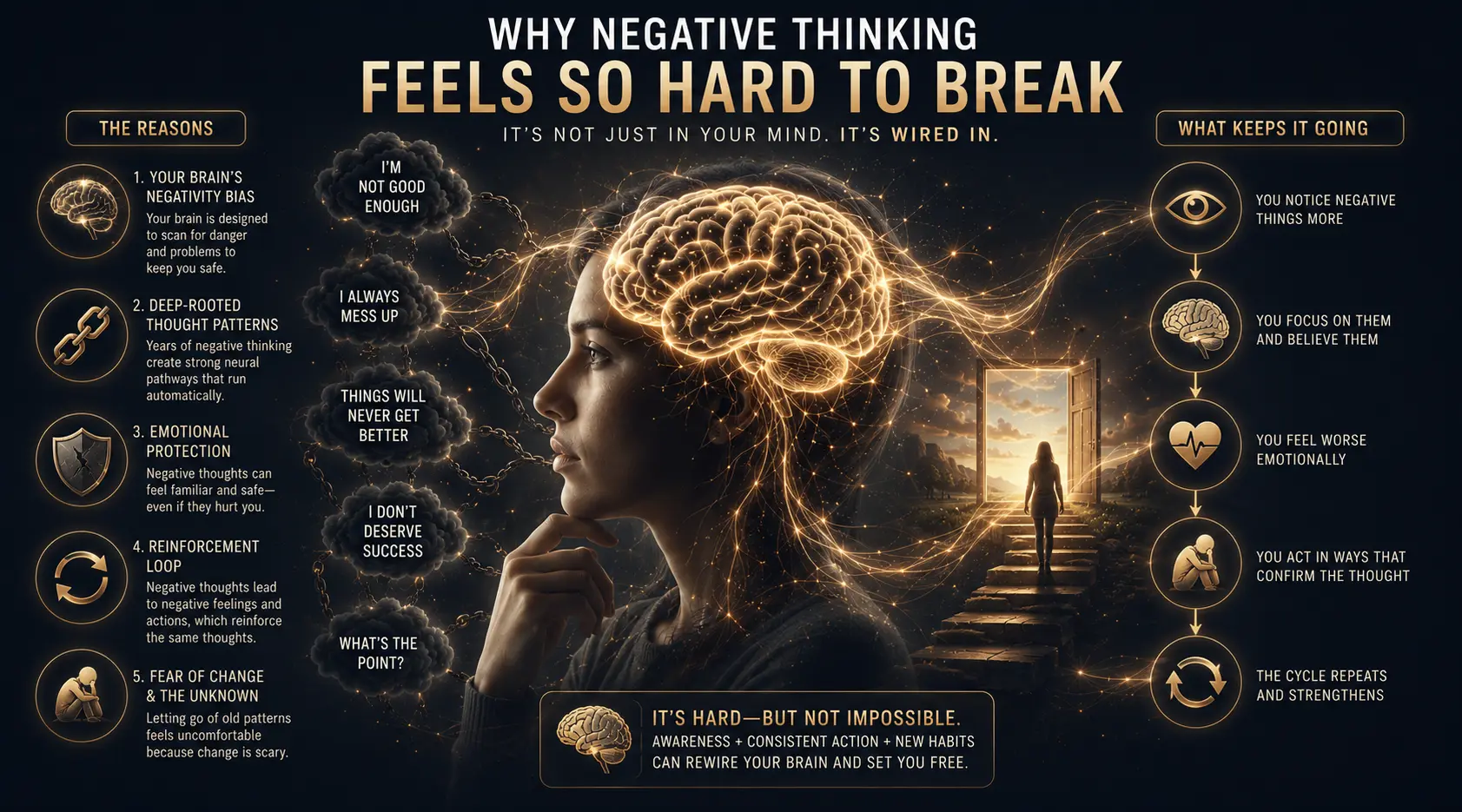
Subconscious reprogramming works where “just think positive” fails because it rewires the automatic pattern driving the negative thought, rather than fighting the thought at the surface.
At Mind Alchemy, this distinction is the foundation of every client engagement: lasting change lives below the conscious mind, not above it.
Quick Answer
Subconscious reprogramming works because it changes the automatic beliefs and emotional patterns driving your thoughts, while positive thinking only changes what you consciously tell yourself. When stress, fear, or self-doubt arise, your subconscious patterns usually override conscious intentions. The key differences:
- Positive thinking works at the conscious level.
- Subconscious reprogramming targets automatic beliefs.
- Lasting change comes from changing the pattern, not fighting the thought.
- Techniques like hypnosis, visualization, and somatic work reinforce healthier responses over time.
This article explains why positive thinking often falls short and how subconscious reprogramming creates more sustainable transformation.
Why Positive Thinking Fails When Your Subconscious Is Running the Show
Positive thinking fails because it operates at the wrong level of the mind. Your conscious mind can hold a new thought for a while, but the moment stress hits or your willpower depletes, the older, deeper pattern snaps back into place.
Social psychologist John Bargh at Yale, whose research on automaticity has become foundational to the field, found through decades of experimental work that the vast majority of human behavior is automatic. Bargh and Chartrand (1999), writing in American Psychologist, estimated roughly 95% of behavior is automatic, with the broader literature placing the range between 90 and 97 percent. That means the positive thought you are consciously choosing is competing with a system that runs almost everything else, and the system wins most of the time.
Why awareness is not enough
Why does awareness of a subconscious program not stop it from running? Because awareness is a conscious process and the program operates subconsciously. The awareness lives in the explicit memory system; the program runs in the implicit system. These are structurally distinct, and research consistently shows that explicit-level insight does not automatically transfer to implicit-level change.
There is also a neurological backlash worth understanding. Cognitive dissonance research shows that asserting “I am worthy” against a subconscious “I am not worthy” creates measurable internal stress, and the brain often resolves the mismatch by strengthening the original protective belief. The tool was never designed for the layer where your pattern actually lives.
Why positive thinking feels like it works at first
Positive thinking often creates an immediate boost because it is new and motivating. Trying a different mindset triggers the brain’s reward system, releasing dopamine, which increases optimism and motivation. But as the novelty fades, dopamine levels return to normal.
At the same time, positive thinking relies on willpower, and willpower is limited. Stress, fatigue, and setbacks make it harder to consciously override the subconscious patterns you have repeated for years. As a result, many people experience progress followed by relapse.
This is not a lack of discipline. It simply means the underlying subconscious belief has not changed. Lasting transformation happens when you reprogram the pattern driving the thought, not just the thought itself.
Where Negative Thought Patterns Actually Come From
Negative thought patterns are not personal flaws. They are learned subconscious patterns developed for protection.
During the first seven years of life, the brain is particularly malleable, operating primarily in theta brainwave activity (4 to 8 Hz), a state associated with deep relaxation and high suggestibility. Because children are so receptive during this window, the experiences they are exposed to do not just shape preferences; they imprint foundational beliefs about the world and themselves directly into the subconscious mind.
How these beliefs are formed
A child who receives repeated criticism about their performance does not conclude “my parent was stressed today.” They encode something closer to “I am not enough, and failure is dangerous.” That encoding becomes the subconscious filter through which every future challenge is processed.
Childhood-formed beliefs prove especially stubborn even when directly contradicted by evidence, because changing them requires restructuring interconnected neural networks linking facts, emotions, and identity. Logical argument alone cannot do that job.
This is why the question of how to stop negative thinking cannot be answered with a list of reframes. The thought is a symptom. The encoded belief is the source.
How Subconscious Reprogramming Works at the Root
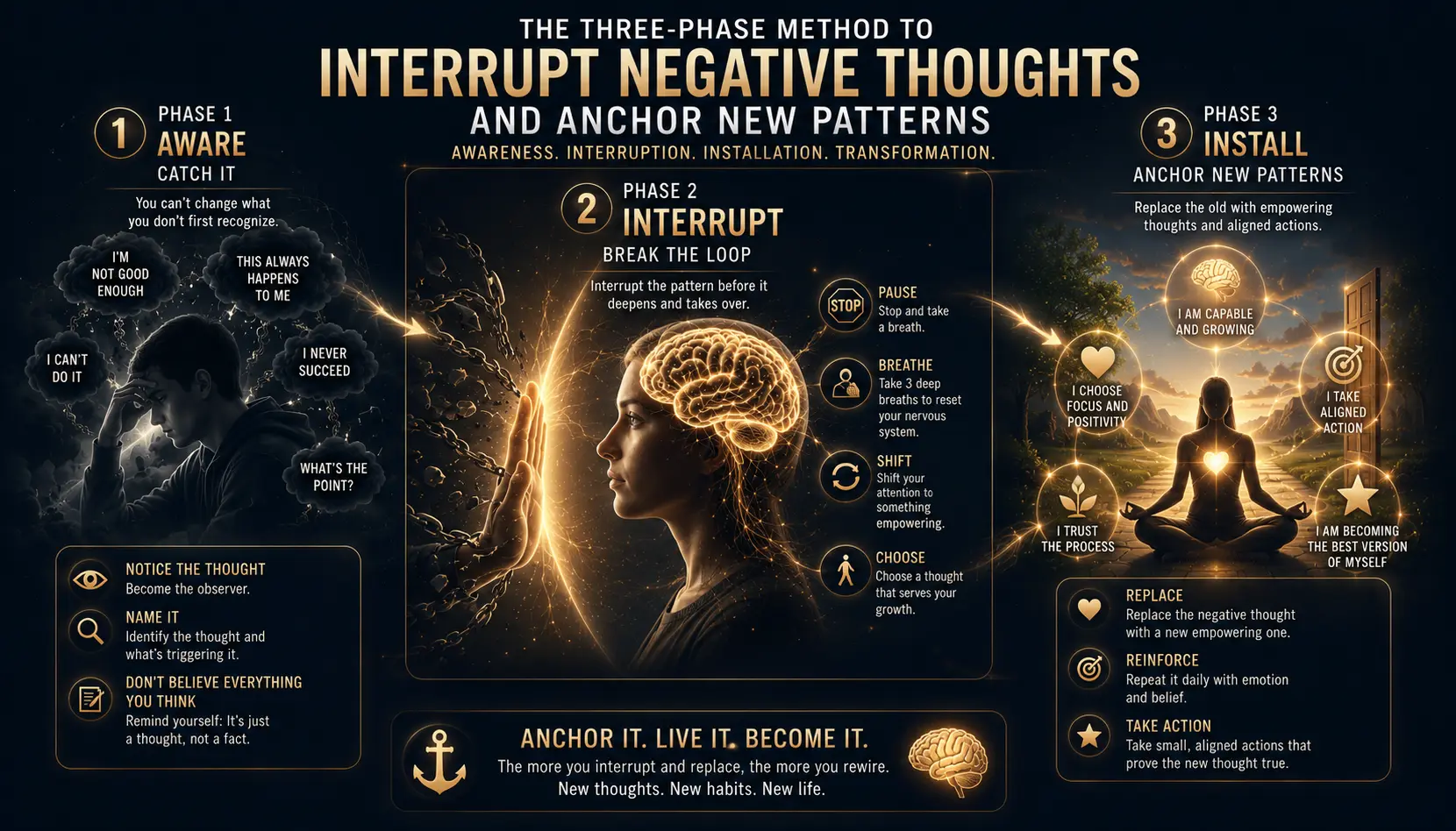
Subconscious reprogramming, the practice of accessing and rewriting automatic belief patterns stored below conscious awareness rather than managing the thoughts those patterns produce, is where the real work of personal transformation happens.
Fear and self-doubt are one pattern, not two problems
Most people treat fear and self-doubt as separate issues to tackle separately. Both are outputs of the same root program: a subconscious threat-detection system that learned, early on, that certain kinds of failure or rejection are dangerous.
Fear is the alarm; self-doubt is the story the alarm tells. Trying to overcome fear and self-doubt by arguing with the story is like turning down the smoke alarm while the wiring still smoulders.
Subconscious reprogramming targets the wiring directly, which is why both the alarm and the story quiet together. Clients describe it as the trigger simply losing its grip rather than something they learned to manage better. The thing that used to derail them just stops landing the same way.
How the reprogramming process works
The theta brainwave state that makes children so receptive to early conditioning is also the access point that most subconscious-rewriting methods recreate in adults. Hypnosis coaching, guided visualization, and somatic techniques all work by returning the brain to a receptive state where new patterns can be installed at the level they were originally formed.
When someone is in deep relaxation or hypnosis, the critical conscious mind steps back, allowing direct communication with the subconscious, where a skilled practitioner can introduce new suggestions, reframe old memories, and build new emotional associations with previously triggering situations.
At Mind Alchemy, Kathy uses the proprietary 3-Phase SoulPrint Method, a structured approach that blends her software engineering background with evidence-informed subconscious reprogramming principles. Each phase targets a specific layer: identifying the root pattern, dissolving its emotional charge, and installing a new self-identity that holds under pressure. You can read more about the approach in the guide on how to reprogram your subconscious mind.
Positive Thinking vs. Subconscious Reprogramming
| Positive Thinking | Subconscious Reprogramming | |
|---|---|---|
| Works on | Conscious thought | Automatic subconscious pattern |
| Requires | Ongoing willpower | Repeated subconscious reconditioning |
| Holds under stress? | Rarely | Yes, once the root shifts |
| Addresses fear and self-doubt? | Manages symptoms | Dissolves the source |
| Typical format | Daily affirmations | Hypnosis coaching, structured method |
The difference is not how hard you try. It is the level of the mind you are trying to change. Genuinely confronting the subconscious pattern rather than papering over it is harder in the short term and far more durable in the long run.
How Is Subconscious Reprogramming Different From Therapy or CBT?
Subconscious reprogramming and therapy operate on different layers of the mind, and understanding which layer you need to work on changes everything about how you approach the problem.
- CBT helps you notice “I’m catastrophising” and build a more rational counter-thought. That is genuinely useful. But if the catastrophising is driven by a subconscious pattern that fires before your rational mind even engages, the counter-thought arrives too late.
- Hypnotherapy deals directly with the unconscious mind and tends to achieve faster results because it bypasses the lengthy process of consciously working through each symptom first.
- Transformational coaching with subconscious reprogramming is not a replacement for therapy when therapy is clinically indicated. Therapy processes the past; subconscious reprogramming installs a new operating pattern for the future.
What distinguishes a structured self-identity coaching approach like the SoulPrint Method is surgical specificity: a named, 3-phase protocol targeting the individual’s exact subconscious pattern, applied with precision rather than as a mass-market framework.
If you have done therapy and still find yourself looping on the same fear or self-doubt, run this check on your own situation before assuming you have hit a ceiling: have you addressed the conscious layer without ever touching the automatic one underneath? A subconscious reprogramming coach works precisely at that gap.
That work happens entirely online, which means the same pattern-level approach is available wherever you are, including California and Texas.
CBT vs. Traditional Therapy vs. Subconscious Reprogramming
| Approach | Works on | Typical duration | Best for | Limitation |
|---|---|---|---|---|
| CBT | Conscious thought patterns and cognitive reframes | Weeks to months | Catastrophising, distorted thinking, behavioural habits | The reframe fires after the automatic emotional response, so the pattern still triggers first |
| Traditional therapy | Past experiences, emotional processing, relational patterns | Months to years | Trauma processing, grief, relational wounds | Insight into the past does not automatically update the subconscious pattern driving present behaviour |
| Subconscious reprogramming (SoulPrint Method) | Automatic subconscious belief patterns at the root level | Automatic responses begin shifting within weeks; identity-level consolidation over months | Persistent fear, self-doubt, and self-sabotage that survive conscious-layer work | Requires a receptive state and a structured method; less suited to acute clinical presentations where therapy is indicated |
The Bottom Line
Positive thinking can improve your mindset in the moment, but lasting change comes from addressing the subconscious beliefs that shape your automatic thoughts, emotions, and behaviors.
If you have spent years trying to think differently but keep returning to the same patterns, the issue may not be your effort. It may be the subconscious programming beneath it. That is where subconscious reprogramming can make the greatest difference.
Key Takeaways
- When willpower runs out, the subconscious pattern underneath conscious thought reasserts itself. That is a neurological reality, not a personal failure.
- Negative thought patterns are encoded in childhood as survival logic, which is why they resist logical argument and require restructuring at the level where they were formed.
- Fear and self-doubt share a single root program. Addressing that root dissolves both, rather than leaving you managing each symptom in rotation.
- CBT and therapy do valuable work at the conscious layer. Subconscious reprogramming works on the automatic layer beneath it, making the two complementary for different depths of change.
- If your mindset has stayed stuck despite years of effort, the missing piece is almost certainly pattern-level work.
Kathy’s SoulPrint Method is designed to identify and transform those deeper patterns so lasting change becomes possible. Schedule a consultation to discover what is driving your recurring patterns and how the SoulPrint Method can help you change them.