Why Do I Self-Sabotage My Relationships? The Hidden Causes

Kathy Khodi-Elhami
Transformational Subconscious Coach
Relationship self-sabotage is usually unconscious self-protection, which says little about your character. If you keep pushing away people you love, fear of being hurt or rejected is likely creating the distance you say you don't want. Kathy, a former software engineer turned transformational subconscious coach, builds a tailored plan around each client's subconscious patterns, goals, and challenges.

Why do I keep pushing away the people I love?
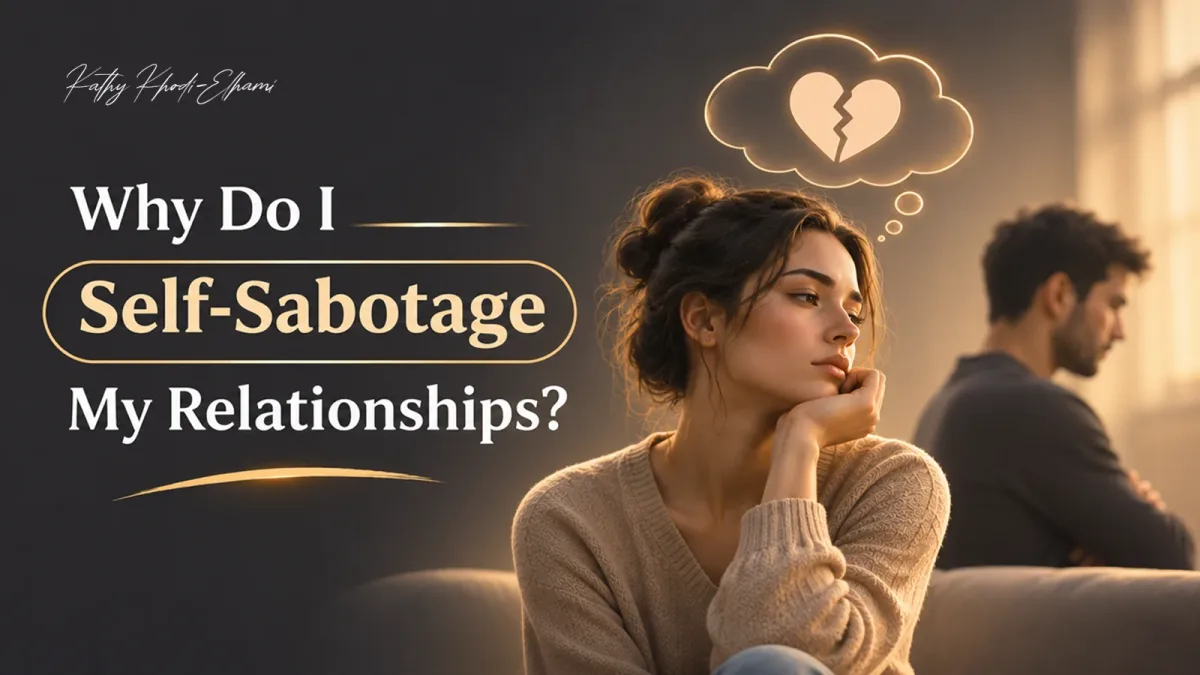
You push people away because part of you has learned that closeness is unsafe. Relationship self-sabotage means conscious or unconscious behavior that damages a relationship you want, and an expert links it to past experiences and fear of being hurt.
That is the paradox. You crave connection, yet you pick the fight, go quiet, or leave first. Kathy Khodi-Elhami's self sabotage coaching describes this as protection: pushing people away guards against rejection, procrastination guards against failure, and quitting guards against vulnerability.
Think of a smoke detector tuned too sensitively. It sounds the same for a burnt piece of toast as for a real fire. Closeness can set off your protective reaction the same way, even when the room is perfectly safe.
What does relationship self-sabotage actually look like?
It looks like creating conflict, withdrawing, or testing a partner just as intimacy deepens. It includes picking fights, withdrawing after intimacy, criticizing a partner, testing whether they will abandon you, and ending relationships before you can be left.
The behaviors researchers have named, are:
- partner attack
- pursuit
- withdrawal
- defensiveness
- contempt
- trust difficulties and jealousy
- destructive behaviors
- affairs
- harassment or abuse
Most readers recognize two or three of these as their own signature moves.
Timing is the tell. The pattern tends to follow increasing closeness, commitment, or vulnerability. Real concerns about a partner exist, but sabotage shows up as a reaction out of proportion to them.
A quick self-check
Ask yourself these questions:
- Do I start arguments after an especially warm or close stretch?
- Do I go cold or busy right after we get vulnerable?
- Do I look for flaws in a partner who has given me no reason to?
- Do I test whether they will stay, then feel proven right when they struggle?
- Do I leave, or imagine leaving, before I can be left?
If you answered yes to two or more, the pattern is worth examining. It does not mean you are broken. It means your protective system is working overtime.
Where does the pattern come from, and why can't willpower fix it?
The roots usually lie in early relationships and the beliefs you formed about love. A study of therapy clients found 6 overlapping reasons: self-protection, insecure attachment, negative self-concept, relationship beliefs, difficulty coping with challenges, and avoiding commitment. Talks-pace adds trauma, fear of abandonment or intimacy, and trust issues.
How a childhood experience becomes an adult reaction
Picture a child whose parents withdrew affection after every disagreement. The young mind draws a fast conclusion to stay safe: "closeness gets me hurt." Years later, a partner says "I love you," and your body registers a threat. You start a fight, and the distance feels like relief.
Kathy's subconscious reprogramming holds that by age seven the subconscious has absorbed thousands of beliefs about worth, safety, and possibility. A related post on reprogramming the subconscious mind says children spend much of their waking hours in theta brain states, the slow-wave state also induced by hypnosis. This is Mind Alchemy Coach's perspective on how such beliefs form, not settled consensus.
Why insight alone often falls short
Understanding the pattern rarely switches it off. The same post argues the behavior-driving pattern sits below conscious awareness, so effort at the surface misses the source. Encoded makes a similar point: conscious effort and insight may work temporarily but do not durably update the programs underneath.
The limiting beliefs coach page names a belief behind many relationship patterns: "I have to earn love. If I stop performing, people will leave." Beliefs like that keep people performing indefinitely, never trusting they are enough as they are.
The less obvious driver: fear of success
Fear of success applies to love too. When a relationship goes well, your subconscious can read it as a threat: more visibility, higher expectations, the possibility of loss. So the better things get, the harder you may pull away. Many people wrongly assume self-sabotage only happens in bad relationships, when the good ones often trigger it hardest.
Which explanation fits you?
| Driver | What it feels like | Typical behavior |
|---|---|---|
| Fear of abandonment | Constant worry they will leave | Testing, clinging, accusations |
| Fear of intimacy | Closeness feels suffocating | Withdrawing, avoiding commitment |
| Low self-worth | "I don't deserve this" | Criticizing yourself, then your partner |
| Fear of success | Good things feel dangerous | Conflict when things go well |
How do you start breaking the cycle?
Start by catching the moment between the trigger and the reaction. Kathy's guide to stopping self-sabotage advises honest communication instead of assumptions, working on your own insecurities, and avoiding emotional tests of your partner.
A practical sequence
- 1Notice the trigger and the urge. Note what happened right before you wanted to fight or withdraw.
- 2Name the belief underneath. Ask what you would have to believe about yourself for this reaction to make sense.
- 3Pause before acting. Even ten minutes breaks the automatic loop.
- 4Say the feeling out loud. "I'm scared you'll leave" does less damage than a three-day silence.
When you tell a partner, share the feeling and the concern directly. Skip the assumptions and the tests. Mind Alchemy Coach's guide to stopping self-sabotage gives the same advice.
Deeper routes
Therapy is the right call when trauma or attachment wounds sit behind the pattern. It recommends professional support when trauma or past relationship wounds are driving harmful behaviors. If the pattern is also showing up in confidence and worth, a confidence and self worth coach offers another angle.
Change takes time. Mind Alchemy Coach's reprogramming guide describes awareness in weeks 1 to 3. Early shifts show up in weeks 3 to 6. More natural responses develop in weeks 6 to 12. Identity integration takes 3 to 6 months.
Subconscious-level work is where Mind Alchemy Coach fits. Kathy's SoulPrint Method runs in three parts that make up her coaching approach. ReProgram clears limiting patterns. ReCreate rewires identity. ReConnect rebuilds trust in inner knowing. It comes as one-on-one sessions, a self-paced membership, or a group coaching program, so budget and commitment can set the format. This is transformational coaching, and a licensed professional is the right call for diagnosed conditions or abuse. If subconscious-focused support sounds like your next step, you can book a free consultation with Kathy.
Final Thoughts
Self-sabotaging relationships does not necessarily mean you do not want love. Sometimes, it means you have learned to protect yourself from the very vulnerability that makes meaningful relationships possible.
You might withdraw when someone gets close, question their intentions when things are going well, or create distance before they have a chance to hurt you. These reactions can feel automatic, but they are patterns you can learn to recognize and change.
The first step is not to blame yourself. It is to become curious about what happens beneath your reactions. Notice which situations trigger your fear, identify the beliefs influencing your behavior, and practice expressing your feelings instead of acting on every emotional impulse.
Remember that healthy relationships do not require you to be perfect. They require honesty, emotional awareness, communication, and a willingness to work through difficult moments together.
If unresolved trauma, persistent anxiety, or attachment-related difficulties are affecting your relationships, working with a licensed mental health professional can help you understand and address these patterns. Subconscious-focused coaching may also complement personal development goals, provided it is not treated as a replacement for appropriate mental health care.
You do not have to keep repeating the same relationship patterns. Understanding why you push love away with MindAlchemy can be the beginning of learning how to let it in.
Frequently Asked Questions
Key takeaways
- Pushing people away is usually protection, an overturned alarm reacting to closeness as if it were danger.
- The pattern follows intimacy, so notice what happens right after warm, vulnerable moments.
- Childhood beliefs like "closeness gets me hurt" drive adult reactions below conscious awareness.
- The first practical move is to pause between the urge and the action, then name the feeling aloud.
- If trauma or attachment wounds sit underneath, start with therapy; if the belief layer is the sticking point, add subconscious-focused coaching.